
Introduction
Now 50 years down, the Biological Weapons Convention (BWC) has gained prominence. It is basically the first multilateral disarmament treaty to ban an entire category of weapons of mass destruction. Since its inception the Convention has been a key component of the global disarmament regime, codifying a strong and long-standing norm that the use of biological weapons would be repugnant to the conscience of humanity. The total 188 countries’ adherence to the convention itself is a testimony to the importance and significance of the BWC as a safeguard to mankind. BWC has been put forth on the basis of Geneva Protocol, which was signed in 1925, to eliminate the threat of weapons of mass destruction. This research article provides the past and present of the convention and the ‘glimmers of hope’ from the Ninth Review Conference’ which was held in November 2022 to make thoughtful proposals for approaches to identify and respond to the potential challenges in the future.
About BWC
The seeds of the Biological Weapons Convention were sown after World War I i.e after 1918 and the formation of Geneva Protocol of 1925. The discussions started on closing the loopholes in the language of the Hague Conventions of 1899 and 1907. The two prominent improvements were to be made in this regard.
First, in order to ban not simply the ‘projectiles’ whose sole object is ‘The Diffusion’ of these weapons but to ‘prohibit the use of Asphyxiating, Poisonous or other gases and all the analogous liquids materials and devices.’
Second, in the language of the Geneva protocol, ‘To ban the use of Bacateriological methods of warfare.’
The Protocol, however, only banned the use of these weapons; its remit did not extend to their production, use, stockpiling, acquisition or retention. Nor did it have any enforcement mechanism. In addition, some signatories submitted reservations, and retained the right to retaliate in kind, if attacked or against non-signatories. It provided the normative framework for treaty-based prohibitions of weapons of mass destruction, not only in the form of the Biological Weapons Convention, but the Chemical Weapons Convention and even the Treaty on the Prohibition of Nuclear Weapons and the Treaty on the Non-Proliferation of Nuclear Weapons (in particular, its Article VI).(The Biological Weapons Convention at Fifty – UNODA, 2025)
At the same time, it became clear that the prohibition on use of biological weapons, as contained in the Geneva Protocol, was the foundation and not the capstone of efforts to rid the world of biological weapons and ensure against their return and use
After World War I, the new era of arms racing began in the form of cold war between the United States of America and the then Soviet Union (USSR). But the main threat of weapons of mass destruction was more of a nuclear weapon. Both the sides, rightly remembered for a build-up of nuclear weapons and there was a clear threat of immediate and existential annihilation.
However, and absence of any prohibition against any activities, the arms racing of the Cold War era also entailed the development of biological weapons by both sides. Growing concerns about the dangers of biological weapons, and the likely inability to contain or control them once deployed, lent themselves to an ongoing normative shift in the international community away from unconstrained arms racing and towards more meaningful constraints on weapons of mass destruction beyond simply preventing their use.
This led to successful negotiation on the ban of the entire class of weapons of mass destruction in the form of Biological Weapons Convention. This convention was explicitly built on the basis of Geneva protocol, saying it as a ready-made foundation of the convention which prohibits the use of weapons of mass destruction. Article VIII of the Convention made clear that “Nothing in this Convention shall be interpreted as in any way limiting or detracting from the obligations assumed by any State” under the Geneva Protocol. (The Biological Weapons Convention at Fifty – UNODA, 2025)
In doing so, the BWC represented a shift from principle to practice, by virtue of its prohibition against development, production and stockpiling of biological weapons and by containing specific, enforceable provisions
On the centenary of the 1925 Geneva Protocol, its offspring the Biological Weapons Convention has 188 States Parties and four signatories. It has indisputably made the world a safer place. However, the capstone of the elimination of biological weapons, is still not yet in place; in spite of its enforceable provisions, the Convention lacks an enforcement mechanism. In a world where, as the UN SecretaryGeneral António Guterres has said “distrust has replaced dialogue” and amid fears that the nexus between technology and WMD is lowering the barriers to acquisition, it is an understatement to say that there is still work to be done.
The Biological Weapons Convention (BWC) effectively prohibits the development, production, acquisition, transfer, stockpiling and use of biological and toxin weapons. It was the first multilateral disarmament treaty banning an entire category of weapons of mass destruction (WMD). BWC is comparatively short and comprises only 15 articles. Over the years, it has been supplemented by a series of additional understandings reached at subsequent Review Conferences.
The key components of the convention are as below as per given by the United Nations Office of Disarmament Affairs (UNODA):
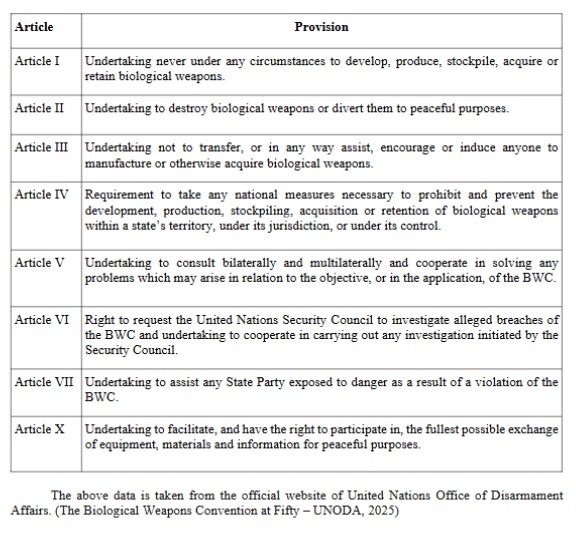
The above data is taken from the official website of United Nations Office of Disarmament Affairs. (The Biological Weapons Convention at Fifty – UNODA, 2025)
BWC States Parties have strived to ensure that the Convention remains relevant and effective, despite the changes in science and technology, politics and security since it entered into force. Throughout the intervening years, States Parties have met approximately every five years to review the operation of the BWC. Between these Review Conferences, States Parties have pursued various activities and initiatives to strengthen the effectiveness and improve the implementation of the Convention. A total of nine Review Conferences has taken place since the first one in 1980.
Evolution of BWC from the past fifty years
The Biological Weapons Convention should not be merely seen as the product of the Cold War, rather it had already gained impetus and the discussions were alongside the prevention of nuclear weapons in the form of 1963 Limited Test Ban Treaty and 1968 Nuclear Non-Proliferation Treaty.
BWC was negotiated by the conference of the committee on disarmament from 1969 to 1972 and then opened for the signature and finally entered into force in 1975 with obvious shortcomings. But the BWC was considered as a ‘real achievement’ not only for the United Kingdom of Great Britain and Northern Ireland (UK), which spearheaded international talks in the area, but also for communities (including scientists) who had pushed for the ban on biological weapons. The Convention “became the first multilateral disarmament treaty to prohibit an entire class of weapons” and “represents a milestone of the international disarmament regime” (Shearer et al, 2023, p.47; Revill and Blancafort, 2023). The first review conference was held in 1980, according to the Article XII of BWC. (CONVENTION on the PROHIBITION of the DEVELOPMENT, PRODUCTION and STOCKPILING of BACTERIOLOGICAL (BIOLOGICAL) and TOXIN WEAPONS and on THEIR DESTRUCTION, n.d.)1
) Significantly, the article XII also notes that such a review conference should also take account of new scientific advancements and developments in the field of biotechnology and microbiology to understand the technological threats to make bioweapons. Therefore, it shows that BWC was nothing just an agreement but was also a mechanism continually built into a regime.
After the initial Review Conference, a further eight have been undertaken. The Fifth Review Conference in 2001 witnessed a degree of acrimony over the United States of America’s proposal to end the Ad Hoc Group mandate to establish a legally binding protocol to strengthen the Convention (Littlewood, 2005). In terms of the BWC’s structure, a more positive outcome was the establishment in 2002 of an Intersessional Programme consisting of annual Meetings of Experts (MXs) and Meetings of States Parties (MSPs), to be held between successive Review Conferences. The Third Review Conference in 1991 saw the establishment of an Ad Hoc Group of Governmental Experts to Identify and Examine Potential Verification Measures from a Scientific and Technical Standpoint which held four sessions from 1992 to 1993. The subsequent Special Conference in 1994 established an Ad-Hoc Group which convened 24 sessions from 1995 to 2001. These decisions increased the requirement for dedicated support given the frequency of meetings under these processes. Therefore, the Office for Disarmament Affairs hired staff on temporary contracts for a few weeks or months at a time to service the meetings. The collapse of the negotiations within the Ad Hoc Group in 2001 brought an end to this process and to the idea of creating a large international organization for the BWC modelled on the Organization for the Prohibition of Chemical Weapons. However, agreement on a new intersessional programme at the resumed Fifth Review Conference in 2002 meant that secretariat support would again be required for the annual Meetings of Experts and Meetings of States Parties to be convened in Geneva. In 2006 Implementation Support Unit (ISU) was established by the review conference. Prior to the creation of the ISU, the BWC lacked any dedicated and ongoing secretariat support. Without regular annual meetings there was little need for a full-time secretariat. Instead, the various predecessors of the current Ge neva Branch of the United Nations Office for Disarmament Affairs provided secretariat and administrative support as and when required, mainly for the five-yearly review conferences. In addition, since 1987, the Office also supported the annual collation and circulation to all States Parties of the annual confidence-building measures (CBM) reports. Writing at the time, Chevrier notes that these sessions provided a substantive forum for discussion and a procedural means for inter-state communication (Chevrier 2002). The Ninth Review Conference in 2022 replaced the MXs with a “Working Group on the Strengthening of the Convention.”
The ISU was mandated to provide administrative support to meetings agreed by the Review Conference as well as support for the comprehensive implementation and universalization of the Convention and the exchange of confidence-building measures. The Seventh Review Conference in 2011 decided that the ISU would also establish and administer the Assistance and Cooperation Database and administer the Sponsorship Programme. Since the ISU was formally launched in August 2007, it has worked to fulfil these mandates. Working with the chairpersons of the annual Meetings of States Parties, a total of 188 States are now party to the BWC.
Current Scenario
As mentioned before, the Biological Weapons Convention is not a fossilized agreement. As mentioned, the BWC, unlike many other international treaties, is not a fossilised agreement. The Review Conferences, inter-sessional meetings and activities of the ISU together create an on-going focus of attention on biological weapons control. The steadily increasing involvement of civil society groups in the BWC adds further scrutiny. Moreover, long-term commentator on the BWC, Malcolm Dando, observes that, where there would otherwise be a geopolitical vacuum, the treaty performs multiple functions that include: (Dando, 2002, p.24)
1. Deterrence of violation, inducing compliance through threat of discovery
2. Reassurance through confirmation that the treaty is being implemented
3. Channel of communication that enables States able to identify and deal with disputes before they escalate
4. Precedent for subsequent, more advanced stages of disarmament
5. Mechanism for distinguishing between major and minor violations
In 2024, a record number of 111 States Parties submitted their annual CBM reports. The Assistance and Cooperation Database currently contains a total of 28 offers for assistance from 12 States Parties and one group of States Parties and a total of 71 requests for assistance from 30 States Parties. In 2024, thanks to voluntary contributions from four States Parties and the European Union, around 60 national experts from developing countries were able to attend BWC meetings in Geneva and participate actively by making statements, participating in side events and having bilateral discussions
The Seventh Review Conference also noted that States Parties in a position to do so could provide voluntary contributions to the ISU to enhance its ability to carry out its mandated tasks.6 Given that the funding received for the ISU from assessed contributions does not cover capacity-building or training activities, such voluntary contributions are crucial for addressing requests for assistance, primarily from developing States Parties. Donors have provided funds to the ISU to enable it to conduct implementation support activities at the request of States Parties, and to employ additional staff to carry out these activities
Given that States Parties agreed to renew the mandate of the ISU at the Seventh, Eighth and Ninth Review Conferences, they clearly value the support that it has provided. In addition to the support that it provides to States Parties, the ISU also acts as the institutional memory of the BWC. At the Ninth Review Conference, States Parties finally agreed to expand the ISU by adding a fourth staff position.
Organisational Shortcomings
Unlike other arms control treaties, the BWC lacks a formal verification mechanism to monitor compliance with the treaty. This makes it difficult to ascertain whether states are adhering to their obligations
The ISU has also faced challenges during its lifetime. The mandate of the ISU is not continuous and has to be reviewed and renewed at each five-yearly Review Conference. The staff members of the ISU are also not permanent UN staff but instead employed on fixed-term one-year contracts. The ISU, as with the BWC as a whole, receives no support from the UN regular budget.8 All these factors make long-term planning and sustainability difficult. The BWC's Implementation Support Unit (ISU) is understaffed and underfunded, further hindering its ability to effectively manage the treaty's implementation and address emerging challenges. The ISU has only four staff members and a budget of ~$2.1 million, while the Organisation for the Prohibition of Chemical Weapons, which oversees the Chemical Weapons Convention, has a budget of roughly $94 million according to NTI. (Essix et al., 2025)
The BWC lacks a clear framework for responding to potential biological attacks, including coordination among state parties, international organizations, and health/security sectors. Advances in bioscience and biotechnology, including synthetic biology and gene editing, pose significant challenges to the BWC's effectiveness. These advancements can be used for both peaceful and harmful purposes (dual use), making it difficult to monitor compliance and prevent the development of biological weapons. (Gerstein & Giordano, 2017)
Future of Biowarfare and Vision for BWC in near future
The future of biowarfare may see a shift towards information warfare, with potential for targeted, small-scale attacks causing significant psychological impact. Advances in biotechnology could also lead to new, more precise biological weapons, requiring increased preparedness and international cooperation. The BWC (Biological and Toxic Weapons Convention) needs strengthening through mechanisms for international cooperation, review of technological advancements, and improved verification to address these evolving threats
The “Pact for the Future” adopted by the Member States of the United Nations in September 2024, underscores the urgent need to strengthen the Biological Weapons Convention (BWC) and reaffirms their shared determination to exclude completely the possibility of using biological agents and toxins as weapons. This endeavour critically relies on the active engagement of the next generation of scientists who are the leaders of tomorrow. The next generation of scientists can positively support these efforts, if they are equipped with knowledge and a strong understanding of the issues relating to the BWC. The role of education and advocacy programmes cannot be overemphasized because when young people are knowledgeable, they become advocates who support the development of, for example, a verification mechanism. (The Biological Weapons Convention at Fifty – UNODA, 2025)
Engaging the next generation of scientists through education and advocacy programmes is key to driving innovation for peaceful purposes. Education is vital, as it helps raise awareness about the dangers of biological weapons as well as the importance of adherence to the BWC. Actively involving the next generation of scientists in BWC-related events provides valuable insights and perspectives on emerging scientific and technological developments. Various youth programmes have been seen to create a massive impact in fostering understanding and cooperation on BWC-related issues. One example is the Youth for Biosecurity Initiative which educates young scientists about the BWC, its history, and significance in preventing the use of biological weapons. This knowledge empowers them to become informed advocates and responsible researchers
Education and advocacy programmes play a critical role as they help promote ethical research. Some of the significant achievements of the Youth for Biosecurity Initiative include the contributions of young scientists in developing the Youth Declaration for Biosecurity and the Youth Recommendations for the Ninth Review Conference of the BWC. These education and advocacy programmes have given the young people who are the next generation of scientists a voice to support efforts to reaffirm the shared determination to exclude completely the possibility to use biological agents and toxins as weapons.
Scientists are at the frontier of biotechnology innovation, and also the first line of defense against technology misuse and abuse. Therefore, to prevent the misuse and abuse of dual-use biotechnology, it is important to meaningfully engage with them on biosafety and biosecurity issues. The delegations of China and Pakistan jointly submitted the “Proposal for the Development of a Model Code of Conduct for Biological Scientists” to the Eighth BWC Review Conference in 2016.3 In June 2018, the BWC Implementation Support Unit (ISU), the Ministry of Foreign Affairs of China and TJU co-hosted an international workshop on ‘‘Building a Global Community of Shared Future for Biosecurity: Development of a Code of Conduct for Biological Scientists” in Tianjin, during which Mr. Ljupčo Jivan Gjorgjinski, then Chair of the BWC Meeting of States Parties, suggested to name this proposal with the term ‘‘Tianjin” to recognize the far-reaching impact of the workshop. Since January 2021, experts from Tianjin University Center for Biosafety Research and Strategy, Johns Hopkins University Center for Health Security and the InterAcademy Partnership (IAP), engaged in active discussions with scientists from more than 16 countries across four continents to improve the guidelines. The efforts led to the final version of the Tianjin Biosecurity Guidelines for Codes of Conduct for Scientists which was endorsed and certified by the IAP on July 7, 2021. The Tianjin Biosecurity Guidelines were then submitted to the Ninth BWC Review Conference in November/December 2022. (The Biological Weapons Convention at Fifty – UNODA, 2025)
Conclusion
The year 2025 marks the 50th anniversary of the BWC. It is a pivotal moment to seize the opportunity and make concrete progress towards strengthening the BWC and its implementation. Education and advocacy programmes offer the platform for which the next generation of scientists can be inspired to achieve the BWC goals and ensure a future free from the threat of biological weapons.
Before a better understanding of the risks of Bioweapons and feasible governance is in place, scientists in different countries should accord with the principles and codes of conduct highlighted in the Tianjin Biosecurity Guidelines and other relevant norms, when conducting research towards creating mirror organisms. This universal adherence to the Guidelines and relevant norms of scientists could mitigate risks from the mirror life research even if national oversight has not yet been adapted to the new challenge.
We should sincerely hope State Parties and other key stakeholders should meaningfully engage with scientists when they take measures to comprehensively address the evolving biothreats and biotechnology advancements for strengthening the implementation of the BWC. Such efforts are critical to realize the future promise of the BWC as a cornerstone of international security.
End Notes:
1. BWC(Article-XII)- Five years after the entry into force of this Convention, or earlier if it is requested by a majority of Parties to the Convention by submitting a proposal to this effect to the Depositary Governments, a conference of States Parties to the Convention shall be held at Geneva, Switzerland, to review the operation of the Convention, with a view to assuring that the purposes of the preamble and the provisions of the Convention, including the provisions concerning negotiations on chemical weapons, are being realised, Such review shall take into account any new scientific and technological developments relevant to the Convention.
2. Document Viewer - “Annual report of Implementation Support Unit”
3. Document Viewer - “Final Document”, Section III, para. 33.”
4. Document Viewer - “Final Document of the Ninth Review Conference”, Section II, para. 25.”
References:
Chevrier, M. I. (2002, December). Disarmament Diplomacy: BWC Report - Waiting for Godot or Saving The Show? The BWC Review Conference Reaches Modest Agreement. Acronym.org.uk; The Acronym Institution (Disarmament Diplomacy). https://www.acronym.org.uk/old/archive/dd/dd68/68bwc.htm
CONVENTION ON THE PROHIBITION OF THE DEVELOPMENT, PRODUCTION AND STOCKPILING OF BACTERIOLOGICAL (BIOLOGICAL) AND TOXIN WEAPONS AND ON THEIR DESTRUCTION. (n.d.). https://front.un-arm.org/wp-content/uploads/2020/12/BWC-textEnglish-1.pdf
Dando, M. (2002). Preventing Biological Warfare (1st ed.). Springer
Essix, G., Stiefel, D., & Yassif, J. M. (2025, March 26). The Next 50 Years: Strengthening the Biological Weapons Convention – Explained. The Nuclear Threat Initiative. https://www.nti.org/riskybusiness/the-next-50-years-strengthening-the-biological-weapons-convention-explained/
Gerstein, D., & Giordano, J. (2017). Rethinking the Biological and Toxin Weapons Convention? Health Security, 15(6), 638–641. https://doi.org/10.1089/hs.2017.0082
Littlewood, J. (2005). The Biological Weapons Convention. Ashgate Publishing, Ltd. The Biological Weapons Convention at Fifty – UNODA. (2025). Unoda.org. https://disarmament.unoda.org/thebiological-weapons-convention-at-fifty/
United Nations. (n.d.). Biological Weapons Convention. United Nations Office for Disarmament Affairs. https://disarmament.unoda.org/biological-weapons/

