
Abstract
The strategic landscape of the Indo-Pacific is increasingly defined by the People’s Republic of China’s (PRC) growing assertiveness, with the Taiwan Strait serving as its most volatile flashpoint. For the democratic world, and particularly for a major regional power like India, the escalating coercive activities directed by Beijing towards Taiwan represent more than a localized dispute. They are a litmus test for the rules-based international order, challenging the principles of sovereignty, maritime freedom, and stability in the Asian commons.
This article provides a strategic analysis of China’s coercive campaign against Taiwan, delineating its multi-domain nature and its parallels with India. It then explores the profound implications for India’s security calculus, economic resilience, and strategic stability in the Indo-Pacific.
Introduction
In the Indo-Pacific, the Taiwan Strait currently stands as the most critical focal point of escalating geopolitical rivalry. Beijing views self-ruled Taiwan as its breakaway territory, and seeks to enforce its claims by a rising tempo of coercive measures. China has deployed a sophisticated, multifaceted strategy encompassing military threats, economic leverage, and disinformation campaigns to undermine Taipei's government and unilaterally shift the status quo without resorting to open warfare. This calculated pressure ranges from massive military manoeuvres simulating a ‘quarantine’ to subtle ‘gray-zone’ actions, such as aggressive coast guard presence and targeted trade restrictions. This determined drive for "reunification" not only jeopardizes the regional power balance but also carries profound, cascading ramifications for international stability and global supply chains.
Despite the geographical distance, the volatile situation in the Taiwan Strait directly impacts India. New Delhi's relations with Beijing are themselves fraught with long-standing strategic tension, an unresolved land border dispute, and China's expanding naval footprint in the Indian Ocean Region (IOR). Crucially, there is now a growing perception that the coercive strategy utilized against Taiwan will be a standardized playbook employed by Beijing against any nation challenging its supremacy in Asia. The deeper implication for India lies in a fundamental restructuring of the regional power dynamic. Should China succeed in annexing Taiwan through coercion, it would inevitably feel emboldened to press its territorial demands against India more aggressively. Therefore, this article posits that China's pressure on Taiwan constitutes a pivotal strategic challenge for India, demanding a thoughtful adjustment of New Delhi's regional policy that reconciles its traditional adherence to strategic autonomy with the immediate requirement of counter-balancing a mutual security concern. The fate of Taiwan, therefore, represents not merely a regional dispute but a critical test case whose outcome will either constrain or unleash China’s future hegemonic ambitions toward New Delhi.
Deconstructing China's Coercive Playbook Against Taiwan
China's pursuit of unification with Taiwan relies not merely on the threat of overwhelming force, but on a layered strategy of coercive activities designed to induce surrender through exhaustion and economic pain. This sophisticated playbook falls short of outright kinetic warfare, yet deliberately escalates pressure across military, maritime, and economic domains, establishing a new and more volatile status quo in the Taiwan Strait. This multi-domain coercion encompasses military, economic, informational, and diplomatic instruments.
Military and ‘Gray Zone’ Coercion
The most visible element of this strategy is the normalization of military intimidation1. Since 2020, the People’s Liberation Army (PLA) has dramatically increased the frequency and scope of its Air Force (PLAAF) incursions into Taiwan's Air Defence Identification Zone (ADIZ), and its naval patrols around the island2. China’s Eastern Theatre Command (ETC) is at the forefront of these illegal activities. This pattern of sustained pressure, which includes the routine crossing of the Taiwan Strait's median line, serves to fatigue Taiwan's defence forces, erode the morale of its pilots and sailors, and continuously test its response capabilities. Chinese actions are designed to demonstrate the PRC’s intent and capability to enforce its claims, while simultaneously normalizing a heightened state of tension.
Complementing these daily encroachments is the strategic utility of simulation, specifically the practice of large-scale, encircling military exercises3. The PLA has repeatedly simulated blockades and maritime "quarantines" around the island, a non-kinetic form of coercion intended to disrupt Sea Lines of Communication (SLOCs) without requiring a shot to be fired4. This model provides a scalable and reversible option that can be used to threaten global supply chains and demonstrate the capability to isolate Taiwan, all the while remaining below the threshold for a full military response from the United States or its allies. These exercises, often following key political events such as visits by foreign dignitaries (e.g., the August 2022 exercises following Nancy Pelosi’s visit), serve as a form of military signaling and intimidation. The goal is to stress the Taiwanese military, degrade its readiness, and shrink its operational space. The increased use of the China Coast Guard (CCG) and maritime militia in these operations further blurs the line between military and civilian enforcement, a key element of Beijing's "gray zone" tactics. The gray zone tactics enable China to keep the dispute below the threshold of conventional armed conflict and yet force Taipei into political concessions.
“Cold Start" Posture and Blockade Drills. Recent PLA exercises indicate a move towards a "cold start-style" operational posture - the capacity to initiate rapid, high-intensity offensive operations without obvious prior mobilization5. This reduces warning time for Taiwan and its allies. Crucially, exercises have increasingly focused on maritime and air "quarantine" or blockade scenarios, aiming to cut off critical imports like energy and food to isolate the island and force capitulation without a costly landing invasion6. Since 2015, China’s top civilian and military authorities have consistently promoted the doctrine of "start fast, end fast" (迅即开战,速决制胜). This strategy emphasizes the critical importance of maintaining constant readiness, executing rapid, integrated operations, and crucially, completing the mission before any external powers can intervene. This focus on speed is clearly reflected in recent developments, particularly a confidential address delivered by Chinese President Xi Jinping to officers of the Southern Theatre Navy (STC) in Zhanjiang on 11 April 2023. During this speech, he instructed the PLA to quickly field new capabilities and units, insisting on a reaction speed so swift that it denies opponents any chance to organize a counter-mobilization7. The Chinese military is also ramping up its capabilities by expanding missile infrastructure in eastern China. It has almost tripled its inventory of precision-attack ballistic and cruise missiles, and now operates 134 air bases that can sustain air operations near Taiwan8. Projections indicate that China's military will be capable of invading Taiwan as early as 20279.
Analyzing PLA Activities Around Taiwan: September to November 2025
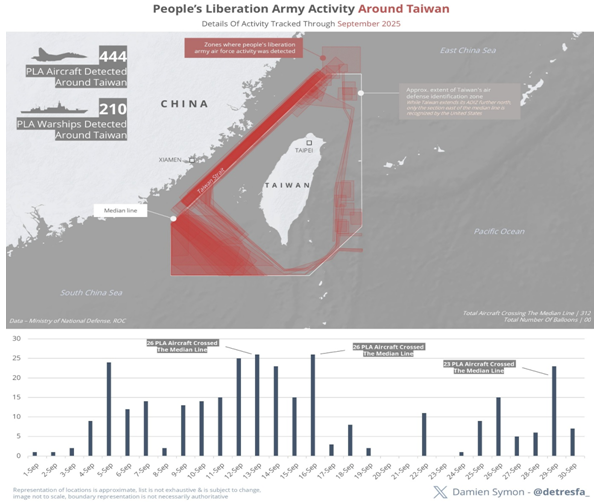
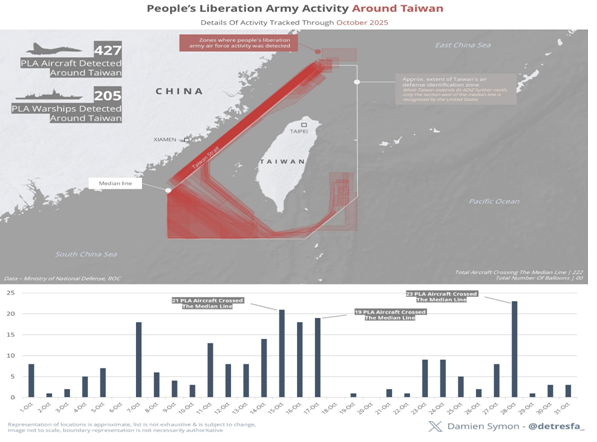
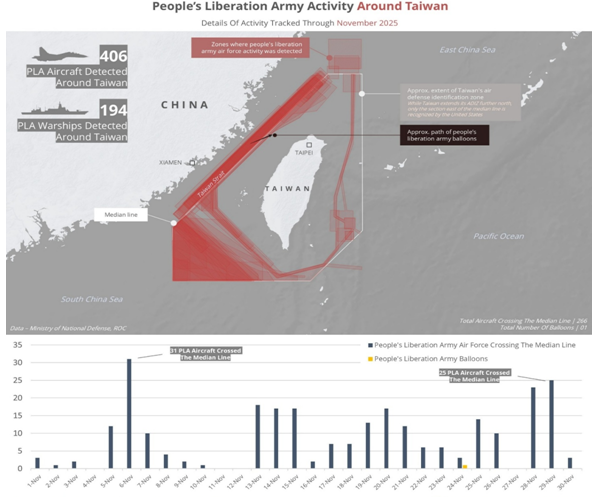
Independent Open-Source Intelligence (OSINT) analyst Damein Symon has been regularly studying and analyzing Chinese military activities around Taiwan. His data shows a sustained pressure by China on Taiwan with no let-up. In September 2025, 312 out of the 444 aircraft detected around Taiwan crossed the median line10. On six days in the month, over 20 aircraft crossed the median line. 210 PLAN warships were detected around Taiwan in the same month. To understand the degree of brinkmanship by China, the 210 warships that were deployed around Taiwan constitute more than the entire warship strength of the Indian Navy. In October 2025, 427 aircraft and 205 warships were detected around Taiwan11. The number of aircraft crossing the median line reduced to 222, while more than 20 aircraft crossed the median line on two days. In November, 266 aircraft and one balloon violated Taiwan’s Air Defence Identification Zone (ADIZ) out of the 406 aircraft that were detected around the island country12. Significantly, on 06 November 2025, 31 aircraft crossed the median line. Over these three months, the Chinese Navy also operated its aircraft carriers around Taiwan, including the recently commissioned Fujian. A careful study of the pattern and quantum of forces deployed around Taiwan indicates a distinct possibility that the Chinese are preparing and practising for an armed intervention into Taiwan.
While the main focus was on the southwestern ADIZ, recent activities have shown a trend toward encircling the island. This includes increased crossings of the Bashi Channel into the Western Pacific, demonstrating longer-range operational capabilities and preparedness for joint combat readiness patrols on all sides of Taiwan, threatening its eastern coast - often considered the safest area13. The overall tempo and scale have intensified from episodic spikes to a sustained, high-level presence. Data from Taiwan's Ministry of National Defense (MND) indicates that the average daily number of detected aircraft has increased significantly over recent years, reflecting a shift toward military strategy and continuous operational dominance rather than purely diplomatic signaling14. Comprehensive visuals for the previous three months detailing China's PLA activity around Taiwan are given in the charts below:-
Fig. 1
Source: X (formerly Twitter) handle of Damein Symon00
Fig. 2
Source: X (formerly Twitter) handle of Damein Symon
Fig. 3
Source: X (formerly Twitter) handle of Damein Symon
Economic Coercion: The "Silent Sanctions"
China’s pressure campaign extends deep into Taiwan's economy through "silent sanctions" - a policy of weaponizing trade for political ends. Rather than imposing broad, international sanctions, Beijing leverages its vast market to apply highly targeted trade restrictions. These often invoke non-trade reasons, such as claiming the discovery of "quarantine pests" to ban imports of Taiwanese agricultural products (like pineapples or grouper fish), or initiating investigations into alleged violations of trade agreements. For instance, in 2024, Beijing suspended preferential tariff treatments under the Economic Cooperation Framework Agreement (ECFA) for petrochemical and other key Taiwanese industries15. These actions, which disproportionately harmed sectors whose constituents tended to support the ruling party in Taipei, were clearly timed to interfere with Taiwanese elections and discourage defiance of the Chinese Communist Party (CCP). China’s actions sought to punish Taiwanese producers in an attempt to generate domestic dissatisfaction with the ruling political party. This economic pressure is strategically applied through the concept known as the "Beiping Model." This historical analogy, derived from the peaceful surrender of Beiping (now Beijing) in 1949, suggests that victory can be achieved through the political capitulation of the target state's elites16. China seeks to leverage the substantial economic dependence of Taiwanese businesses (or Taishang) on mainland markets to foster a cautious, pro-accommodation political environment.
By offering incentives and threatening penalties, Beijing encourages these influential elites to lobby Taipei's leadership to avoid open confrontation, thereby aiming to achieve unification without the military and economic costs of an invasion. This soft-power tactic seeks to erode political cohesion and create a sense of the inevitability of political alignment.
Anaconda Strategy
Beijing’s progressive squeeze on Taiwan’s sovereignty has been based on its "Three Warfares" strategy comprises public opinion warfare, psychological warfare, and legal warfare. China has executed varying components of this strategy on both friends and adversaries. Open, democratic societies such as those of Taiwan are often the target of this strategy that is executed with high intensity17.
Disinformation Campaigns.State-backed entities, often operating from the mainland, deploy sophisticated disinformation and cyber campaigns across social media and digital platforms. The objective is to sow political discord, undermine public confidence in democratic institutions, and promote narratives favouring unification, thereby attempting to disrupt and subvert Taiwanese society.
To increase Taiwan’s isolation, Beijing has regularly severed undersea cables connecting the island to the global internet and communication network.
Cyber AttacksPersistent cyber intrusions targeting critical infrastructure, government networks, and media outlets serve both intelligence gathering and preparatory functions for a potential conflict, aiming to disrupt command and control systems. According to its National Security Bureau, Taiwan faced an average of 2.4 million cyber-attacks daily in 2024, most of which were from China18.
Beijing has been engaged in a sustained diplomatic offensive against Taiwan and has forced many nations to sever diplomatic ties with Taipei. In a recent case of ‘Wolf Warrior’ diplomacy, Chinese diplomats and media used abusive and threatening language against the Japanese Prime Minister, who spoke on Taiwan. China has created considerable strain on Taiwan’s international ties, including its membership in international bodies like the United Nations (UN). Such acts by China narrow Taiwan’s diplomatic options. Sir Alex Younger, former Chief of the UK Secret Intelligence Service, has described China’s campaign against Taiwan as “a textbook on subversion, cyber and political harassment”19. This all-encompassing strategy of China represents a traditional ‘Anaconda strategy’ that is designed to tighten gradually until Taiwan submits due to isolation and demoralization.
The Illusion of Deterrence: India's Size Does Not Deter China's Coercion
Since independence, one of India’s major foreign policy concerns has been the relationship with China. Official statements on the Indian side have regularly downplayed the underpinnings of the strategic rivalry and Chinese malfeasance towards India. Some writings by the so-called ‘China experts’ and diplomats have also favoured an accommodating policy towards China, conveniently overlooking the multi-domain threat we face from China. Evidently, the proponents of such a policy suffer from what is termed in psychology as an ‘Optimism Bias.’ In the context of diplomacy and national security, optimism bias leads decision-makers to underestimate the probability of conflict or the severity of a rival's hostile intentions. Indian policy on China has often displayed an optimism bias. This led to a profound underestimation of China's territorial ambitions in the Himalayas and a neglect of military preparedness along the Line of Actual Control (LAC). Till India was shaken from its stupor by the large-scale Chinese intrusions in Ladakh in 2020, this diplomatic optimism directly influenced operational and strategic negligence.
The huge difference between India and Taiwan in factors such as geography, size, population, and military power may habitually lead to downplaying the extent of the threat from China to India. Statements by some political leaders and in the seminar circuit frequently cite “India is too big and powerful to be cowed by China”, when comparisons are drawn to China’s behaviour with Taiwan and with India. This proposition misses quite a few fundamental facts. China has devoured Indian territory and seeks more. It openly propagates “Taiwan’s reunification” with mainland China - a euphemism for grabbing the territory of Taiwan, just as it harbours designs to assimilate Arunachal Pradesh. In both cases, the Chinese have spun a narrative that these regions were historically a part of China.
By deliberately employing ‘negationism’ - the denial of undisputed, well-documented historical facts and the most extreme form of historical revisionism, China has woven strange ‘fairy tales.’ This proves that China has made no distinction between Taiwan and India, regardless of the size, population, and power of India.
Asymmetric Warfare. Like Taiwan, India too has faced and continues to face the "Three Warfares" and gray zone tactics20. The cyberattacks on India’s critical infrastructure linked to Chinese entities mirror the cognitive and cyber warfare directed at Taiwan. Chinese cyber warfare against India is not a new phenomenon. A strategy of “killing us softly”21 has long been employed and continues unabated. China’s strategic encirclement of India through economic inducements, security partnerships, nuclear proliferation, and political interference in India’s neighbourhood belies Chinese claims of friendship towards India. Beijing refuses to negotiate a settlement to the border issue. On the contrary, it engages in ‘legal warfare’ by renaming parts of Arunachal Pradesh. By “agreeing” to consider the supply of items critically required by India, such as tunnel boring machines, rare earths, and opening the Mansarovar pilgrimage, China has created an illusion of its softening stance towards India. The reality is different and grim. The recent case of an Indian citizen from Arunachal Pradesh being detained illegally and treated inhumanely in Shanghai is a stark reminder of China’s continued resort to coercive gray zone tactics. On trade, China remains unrelenting in denying meaningful market access to key Indian products and industries. India’s annual bilateral trade deficit of US$100 billion is strategically used not only to economically coerce India but also to strengthen the PLA. India’s deep, structural economic dependence on China represents a significant vulnerability that Beijing could easily exploit in a crisis, mirroring its economic coercion against Taiwan. China has been active in propagating an “anti-India” chronicle in India’s neighbourhood and amongst countries of the global south. In essence, China's efforts involve both active influence operations (covert social media campaigns, economic pressure) and strategic media narratives designed to undermine confidence in India's regional and global leadership capabilities.
Strategic Implications for India
The Chinese military and coercive buildup around Taiwan have profound and multifaceted implications for India, directly affecting its strategic autonomy, border security, economic resilience, and its role in the emerging Indo-Pacific security architecture. It presents a geopolitical as well as geoeconomic challenge. India’s core strategic objective remains the maintenance of a Free and Open Indo-Pacific (FOIP). Instability in the Taiwan Strait directly undermines this vision. The Taiwan Strait and the broader South China Sea region serve as a crucial artery for global commerce. Nearly 55% of India’s trade with the Indo-Pacific region, including vital commerce with key partners like Japan and South Korea, transits these SLOCs22. A cross-strait conflict or a prolonged Chinese blockade would severely disrupt global supply chains, leading to a catastrophic spike in energy and commodity prices, which would deal a massive blow to India's energy and food security.
Taiwan's self-governance is critical for India, as the island nation serves as an essential economic partner. This partnership ensures a broad stream of trade passes through the Taiwan Strait and into Northeast Asia. The commercial relationship is substantial, evidenced by Indo-Taiwanese trade reaching US $8.2 billion in 2023, with a projected growth rate of 26.6 percent. India's stake is further amplified by its significant trade volumes with Japan (US $22.9 billion) and South Korea (US $27.5 billion) in 202323 . Consequently, India has a profound interest in preserving unrestricted maritime traffic through the Taiwan Strait and the South China Sea. Should any military action toward reunification occur, the consequences for India's economy and commercial interests would be severe, potentially costing the nation as much as eight to nine percent of its GDP, according to a recent assessment by Bloomberg24.
The Quad Imperative. As a key member of the Quad alongside the U.S., Japan, and Australia, India is strategically entangled in the Taiwan question, whether New Delhi explicitly acknowledges it or not. The Quad’s stated goal of maintaining a rules-based order makes a passive response to China’s unilateral alteration of the Taiwan status quo, untenable. While India maintains a carefully ambiguous position (urging restraint and de-escalation), a crisis would force New Delhi to take clearer, high-stakes positions that it has thus far avoided25.
The absence of an Indian statement on the latest China-Japan disagreement reflects deep uncertainty in New Delhi regarding its willingness to challenge Beijing over the Taiwan issue or to firmly endorse the Quad's vision of a Free and Open Indo-Pacific by taking a decisive stand. India’s refrain from calling out China is surprising given that Japan is its strategic partner, and is therefore likely to be perceived by the Quad as demurring in upholding international norms. An armed invasion of Taiwan could throw another possibility. As a major defence and strategic partner of the U.S. and a Quad member, the U.S. may expect logistical assistance for its warships/ aircraft at Indian bases, including the Andaman & Nicobar Islands. India’s naval posture in the Indian Ocean Region (IOR) may raise China’s heckles, potentially escalating tensions on the border. However, such pessimistic thoughts originate more from an awe of perceived Chinese power than a carefully evaluated assessment of the military potential of Quad. It has been argued that enhancing the military power of Quad is the key to countering China’s expansionism, coercion, and revisionism in the Indo-Pacific26. By putting pressure on China’s Achilles’ Heel (the Malacca Straits and the IOR), New Delhi can prevent Beijing from restricting India's options in a Taiwan contingency.
Brahma Chellaney postulates that the attempt to integrate Taiwan serves as a critical test case for China, one that transcends simple territorial gain. It is the proving ground, whether a united security framework among democracies and economic stakeholders can withstand the challenge posed by authoritarian regimes seeking to revise global norms27. China’s provocative actions and brinkmanship in the region risk triggering an armed confrontation that could spiral into a major war. Deterrence through military capability is hence Nulla est alia electio (no other choice/ alternative).
Learning from Taiwan’s Fight Against Chinese Coercion
China’s relentless intimidation of Taiwan offers valuable lessons in the conduct of hybrid warfare on one hand (China) and resilience on the other (Taiwan). That a relatively small island democracy can successfully withstand the might of a major power is a testimony to the steadfast citizens of Taiwan and the values they hold close. Taiwan’s success in building societal and technological resilience against this hybrid aggression offers a crucial template for India’s own security and defence planning. The valuable lessons derived from Taiwan’s development of "resilience as deterrence" against cognitive warfare are highly relevant for other democracies28 such as India, Japan, the Philippines, and South Korea, who have been subjected to Chinese subterfuge. A crucial element of India's strategy in the Indo-Pacific must be building resilience against China's coercive model. This requires a coordinated approach covering both economic de-risking and the adoption of counter-coercion tactics, with Taiwan's experience offering invaluable lessons.
Proactive Narrative Defence. Taiwan treats narrative defence as proactive competition. The government and civil society actively work to counter disinformation. China's cognitive and information campaign in India (e.g., against Indian politicians, or during military stand-offs) mirrors the political warfare directed at Taiwan. India must learn to use open-source intelligence and civilian technology to identify, debunk, and rapidly expose China-backed disinformation campaigns29.
Media and Digital Literacy. Taiwan focuses on public education and media literacy to inoculate its population against manipulation. India could benefit from integrating media literacy programs to enhance societal immunity to propaganda that aims to sow political/religious discord or undermine trust in democratic institutions30.
Asymmetric and Hybrid Capabilities (Gray Zone). Taiwan's military strategy emphasizes agility, survivability, and cost-effective deterrence over conventional parity, which is crucial for India given the resource imbalance with China. Taiwan is prioritizing asymmetric defence capabilities like coastal defence missile systems, advanced drone technology, and anti-access/area denial (A2/AD) capabilities. For India, this translates to accelerating investment in air power, swarm drones, electronic warfare, and specialized forces for mountainous terrain, shifting the cost-imposition equation on the LAC. Simultaneously, Indian doctrine should embrace developing multi-domain asymmetric offensive capabilities to inflict substantial and unsustainable costs on China.
Law Enforcement Over Military. Taiwan frequently uses its Coast Guard Administration (CGA) for monitoring and responding to routine Chinese maritime incursions and illegal sand dredging. This strategy of responding with a law enforcement vessel rather than a warship keeps the response below the threshold of military conflict while still asserting jurisdiction and publicizing the incursions31. India can judiciously and selectively apply this philosophy on its maritime expanse to counter ambiguous gray zone operations.
Transparency as Deterrence. Taiwan’s policy of publicizing Chinese military and gray zone activities (e.g., releasing daily PLA aircraft statistics) exposes Beijing’s coercion to international scrutiny. India must similarly increase transparency in documenting and reporting Chinese incursions and cyber-attacks. Not only will it help enlighten our population about the nefarious designs of China, but also help build a case for collective international action.
Tech Diplomacy. India should leverage its growing technological capabilities in IT services sector and Digital Public Infrastructure (DPI) to strengthen partnerships with fellow democratic nations, especially within the Quad framework. This cooperation should guarantee that the participating countries possess the means for sharing cyber threat intelligence and developing quick response mechanisms collectively32.
Network of Excellence. Taiwan has sought to build a regional ‘Network of Excellence’ to share lessons on countering maritime gray zone issues and lawfare. India should proactively establish bilateral and multilateral platforms with Taiwan, the Philippines, Japan, and other affected nations to institutionalize this sharing of expertise33.
India's Strategic Options and Policy Pathways
India’s path to growth and prosperity is dependent upon a stable Indo-Pacific where the balance of power is not tilted in China’s favour. Building individual capacities is time-consuming and costly. However, forming strong partnerships, including quasi-military alliances with nations at the receiving end of Chinese belligerence will economize costs, shorten timelines in building capacities and provide a credible deterrent to China. Questions may arise if such arrangements will compromise India’s strategic autonomy. The counter-argument is that in the face of a rising, revisionist power like China, strategic autonomy must maximise India's options and capabilities. Quasi-alliances become a tool to strengthen autonomy, not restrict it. Strategic autonomy is only viable when a nation possesses the requisite Comprehensive National Power (CNP) to make independent choices. China's assertiveness and the power differential between the two nations limits India's autonomy. By partnering with the Quad and East Asian nations, India can create a collective regional equilibrium. China is less likely to engage in coercive or aggressive actions against an individual nation (India) when it faces a unified front of like-minded regional powers. This can act as a viable deterrence and preserve India's freedom of action. India’s gains with such an alliance could include access to critical military intelligence, advanced technology (via groups like the Quad's Initiative on Critical and Emerging Technologies - iCET), and joint exercises (like Malabar) that rapidly enhance its naval and defence capabilities. Strengthening India's core power through partners makes its autonomy more credible.
India must significantly bolster its security and intelligence exchanges with Taiwan, even if they are termed ‘unofficial.’ This includes sharing best practices on cybersecurity, cognitive warfare defence, and drone technology - areas where Taiwan is a global leader Such cooperation enhances mutual resilience without overtly crossing China's political red lines. India should leverage its rising stature in global institutions to consistently call out and condemn destabilizing gray zone activities by any state, promote a clear defence of international law, freedom of navigation, and a rules-based maritime order. This will strengthen the normative framework that secures India’s own interests in the Indo-Pacific. A crucial element of India's strategy in the Indo-Pacific must be building resilience against China's coercive model. This requires a coordinated approach covering both economic de-risking and the adoption of counter-coercion tactics, with Taiwan's experience offering invaluable lessons.
Conclusion
China’s coercive campaign against Taiwan is a strategic paradigm that encapsulates its aspirations for regional hegemony, demonstrating a willingness to leverage all instruments of national power - military, economic, and informational to alter the status quo. For India, this crisis is not a distant event but a critical challenge that intersects directly with its core security, economic, and geopolitical interests. The primary strategic challenge for New Delhi is managing the risk of Chinese escalation on the LAC while simultaneously contributing to the stability of the Indo-Pacific. A failure to build resilience and strategically align with partners on the Taiwan issue would not only expose India’s burgeoning economy to catastrophic disruption but also grant China significant leverage over India's strategic choices.
Therefore, India’s path forward requires a decisive shift: transforming its economic vulnerability into strategic resilience through supply chain diversification, leveraging partners like Taiwan for critical technologies (e.g., semiconductors), and proactively using the Quad and other forums to strengthen collective deterrence against gray zone tactics and uphold the norms of a peaceful and open Indo-Pacific. However, diplomacy without the backing of genuine hard power is just thin air. China respects strength, and hence, building military power, especially naval, air, and asymmetric capabilities, is essential to underpin India's strategic autonomy and create the necessary deterrence gradient to make Beijing see sense. The strategic stability of the Taiwan Strait and the security of the Himalayan frontier are two sides of the same coin, demanding a coherent, all-of-nation strategy that unifies military readiness, diplomatic leverage, and rapid, indigenous technological development (Aatmanirbharta). In the face of a revisionist China, the choice between partnership and appeasement is existential. Placating Beijing at the expense of partnering with regional democracies, especially Taiwan, will only bring strategic despair and systemic instability to Asia, India included.
Endnotes
1. https://rnamedia.in/international/china-simulates-attacks-on-foreign-ships-in-strait-as-taiwan-expands-intelligence-sharing-with-partners/11443#:~:text=Taiwan%20views%20these%20operations%20as,%2C%E2%80%9D%20took%20place%20in%20April.
2. Benjamin Lewis, Thomas Shattuck, ‘A New Frontier: PRC Flight Activity to the East of Taiwan’, Global Taiwan Brief, Vol 9, Issue 17 available at https://globaltaiwan.org/2024/09/a-new-frontier-prc-flight-activity-to-taiwans-east/#:~:text=The%20main%20point%3A%20Since%20Taiwan's,flights%20east%20of%20Taiwan%20is
3. Bonny Lin, Brian Hart, Matthew P. Funaiole, Samantha Lu, and Truly Tinsley, CSIS Brief, 05 June 2024 available at https://www.csis.org/analysis/how-china-could-quarantine-taiwan-mapping-out-two-possible-scenarios#:~:text=In%20August%202022%20and%20April,Taiwan%20and%20its%20outlying%20islands.
4. Craig Singleton, Rear Adm Mark Montgomery (retd), Benjamin Jensen, ‘Chinese Coercion of Taiwan’s Energy Lifelines: A Contest Taiwan and the West Can’t Afford to Lose’, 17 November 2025 available at https://www.fdd.org/analysis/2025/11/17/chinese-coercion-of-taiwans-energy-lifelines-a-contest-taiwan-and-the-west-cant-afford-to-lose/#:~:text=Through%20consistent%20exercises%2C%20the%20People's,control%20over%20critical%20sea%20lanes.
5. Suyash Desai, ‘A ‘Cold Start’ Military Posture with Chinese Characteristics’, 24 November 2025 available at https://chinapower.csis.org/analysis/pla-cold-start/
6. Estelle Huang, ‘The Taiwan test: Why Europe should help deter China’, 25 November 2025 available at https://ecfr.eu/publication/the-taiwan-test-why-europe-should-help-deter-china/
7. Suyash Desai, op cit
8. Timothy A. Walton & Thomas H. Shugart, ‘Concrete Sky: Air Base Hardening in the Western Pacific’, 07 January 2025, Hudson Institute Report available at https://www.hudson.org/arms-control-nonproliferation/concrete-sky-air-base-hardening-western-pacific-timothy-walton-thomas-shugart#:~:text=now%20has%20134%20air%20bases%20within%201%2C000%20nautical%20miles%20of%20the%20Taiwan%20Strait
9. Estelle Huang, op cit
10. Damien Symon on X (formerly Twitter) @detresfa_ , available at https://x.com/detresfa_ posted on 07 October 2025
11. Damien Symon on X (formerly Twitter) posted on 04 November 2025, https://x.com/detresfa_
12. Damein Symon, https://x.com/detresfa_
13. K. Tristen Tang, Less Politics, ‘More Military: The Outlook for China’s 2025 Military Incursions into Taiwan’s Airspace and Waters’, Journal of Indo-Pacific Affairs, 21 April 2025, available at https://www.airuniversity.af.edu/JIPA/Display/Article/4176900/less-politics-more-military-the-outlook-for-chinas-2025-military-incursions-int/
Ibid
15. Hung Tran, ‘Expect Chinese economic retaliation against Taiwan after the DPP’s presidential victory’, 25 January 2024 available at https://www.atlanticcouncil.org/blogs/econographics/expect-chinese-economic-retaliation-against-taiwan-after-the-dpps-presidential-victory/#:~:text=A%20month%20before%20Taiwan's%20elections,Taiwan's%20discriminatory%20policies%20against%20Chinese
16. ‘The Beiping model: How China could absorb Taiwan without a war’, Lowy Institute, 15 May 2025, available at https://www.lowyinstitute.org/the-interpreter/beiping-model-how-china-could-absorb-taiwan-without-war#:~:text=It%20needs%20only%20to%20offer,to%20its%20leadership%2C%20and%20wait.
17. Dr Philip Shetler-Jones, ‘Taiwan’s Evolving Response to China’s Grey Zone Actions’, 31 March 2025, available at https://www.rusi.org/explore-our-research/publications/policy-briefs/taiwans-evolving-response-chinas-grey-zone-actions
18. Yimou Lee, Reuters, 06 January 2025 available at https://www.reuters.com/technology/cybersecurity/chinese-cyberattacks-taiwan-government-averaged-24-mln-day-2024-report-says-2025-01-06/
19. Dr Philip Shetler-Jones, op cit
20. Eerishika Pankaj, ‘Lessons for India: How Taiwan Handles Chinese Political Warfare’, Global Taiwan Brief, Vol 10, Issue 13, 02 July 2025 available at https://globaltaiwan.org/2025/07/lessons-for-india/
21. Praveer Purohit, ‘Killing Us Softly: Chinese Cyber Warfare Against India’, CASS Journal, October-December 2024, Vol 12, No. 3, pp 1-18
22. Harsh V. Pant, ‘India and the China-Taiwan Conflict: The Military Dimension’, 27 March 2023 available at https://www.orfonline.org/research/india-and-the-china-taiwan-conflict
23. Souhardya De & William Budd, ‘India’s Taiwanese Security Policy: A Priority for Regional Security in the Indo-Pacific’, 02 October 2024, available at https://globaltaiwan.org/2024/10/indias-taiwanese-security-policy/
24. Dhruva Jaishankar, ‘Why Taiwan's Future Matters for India’, 18 January 2024, available at https://orfamerica.org/newresearch/indian-foreignpolicy-2024
25. Ivan Lidarev, ‘China-Japan Taiwan Row: India’s Strategic Hesitations’, 01 December 2025, available at https://www.isas.nus.edu.sg/papers/china-japan-taiwan-row-indias-strategic-hesitations/
26. Praveer Purohit, ‘Enhance the Military Power of Quad for a Stable Indo-Pacific’, FINS Journal of Diplomacy & Strategy, Jan-Mar 2025, Issue No. 1, Vol 8, pp 29-37
27. Brahma Chellaney, ‘Taiwan the fulcrum of deterrence’, Taipei Times, 19 May 2025, available at https://www.taipeitimes.com/News/editorials/archives/2025/05/19/2003837112
28. Eerishika Pankaj, op cit
29. Ibid
30. Dr Philip Shetler-Jones, op cit
31. Huynh Tam Sang, ‘Taiwan’s Coast Guard: Countering China’s Gray-Zone Actions’, 10 June 2025, available at https://pacforum.org/publications/yl-blog-129-taiwans-coast-guard-countering-chinas-gray-zone-actions/
32. Angad Singh, ‘Why India Should Push Back Against China’s Belligerence’, The Diplomat, 18 March 2024
33. Dr Philip Shetler-Jones, op cit

